(코멘트 추가) 악재 속 개최된 COP, 국내외의 성과 리뷰 전문가 의견 25-015(Ver.2) COP30 종료: 적응 재원 확대 촉구, 화석연료 언급은 빠져
2025.11.24. **엠바고 없음** 코멘트 및 자료 추가
|
|
|
- 배경
-
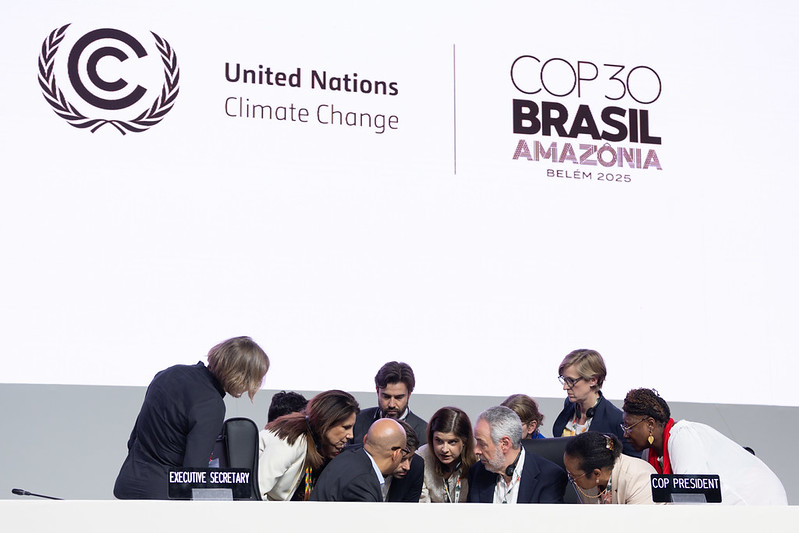
브라질 벨렝에서 개최됐던 제30차 유엔기후변화협약UNFCCC) 당사국총회(COP30)가 폐막일을 하루 넘겨 22일(현지시간) 합의문을 발표하며 종료됐습니다.
-
해수면 상승, 극한기후현상 등 위기에 대한 적응 재원을 2035년까지 현재의 약 3배로 늘리도록 촉구하는 내용이 담겼습니다.
-
대기의 온도 상승 폭을 산업화 이전 대비 1.5도 이하로 억제하기 위해 필요한 기후 대응 행동을 더욱 가속화하는 새로운 이니셔티브를 운영하기로 했습니다.
-
하지만 COP28에서 제기하고 80개국 이상이 주장한 탈 화석연료 전환을 실현할 화석연료 퇴출 로드맵을 마련하는 데 실패해 최종 합의문에서는 언급되지 않았습니다. 산유국의 주장에 기울었다는 비판도 나왔습니다.
-
한국은 2035년까지 온실가스 배출량을 2018년 대비 53~61% 감축한다는 내용의 새로운 국가온실가스감축목표(NDC)를 확정, 발표하고, 국제탈석탄동맹(PPCA)에 가입했습니다. 하지만 여전히 환경단체의 평가에서는 대응이 부족하다는 질타를 받고 있습니다.
-
- 기후위기 측면에서 거둔 주목할 만한 성과나 의의 또는 한계
- 한국 입장에서 주목해야 할 부분이나, 향후 한국이 대응해야 할 점
- 분석 자료를 제작해 보내온 전문가도 있었습니다. 문서로 받을 수 있습니다.
- 해외 SMC(영국, 호주, 스페인, 뉴질랜드)의 전문가 의견도 첨부했습니다.
|
|
|
기자 여러분은 아래 주의사항을 참고해 활용해주시길 부탁드립니다.
- 엠바고는 없습니다. 자유롭게 활용할 수 있습니다.
- 되도록 원문을 그대로 활용해주시길 부탁드립니다.
|
|
|
노윤진 고려대 미래국토연구소 연구교수
*2025.11.24. 추가
제30차 당사국총회(COP30)는 개발도상국의 기후변화 대응을 위해 2035년까지 연간 1.3조 달러(약 1,910조 원)의 기후 재원을 동원하고, 적응 지원을 3배 확대하기로 합의했다는 점에서 취약국 지원 체계를 한 단계 끌어올린 의미 있는 성과를 남겼다. 더딘 협상 진행과 불충분한 기후 재원 공약 등 최근 COP에 제기돼 온 비판을 고려하면 중요한 진전이다.
그러나 화석연료 단계적 폐지 로드맵이 산유국들의 반대로 또다시 합의문에 포함되지 못한 점은 분명한 한계다. COP30 의장 안드레 코레아 두 라고(Corrêa do Lago)는 세계가 기후변화 과학을 부인하는 것이 아니라 경제가, 그리고 그에 기반한 정책이 기후변화를 부인하고 있다고 지적한 바 있다. 산유국뿐 아니라, 우리 모두 이 말을 깊이 새기고 곱씹을 필요가 있다. 지구 기온 상승이 1.5℃를 넘어설 가능성이 커지고 있는 지금, 보다 적극적인 화석연료 전환 노력과 이에 대한 합의가 필요하다.
ro.yoonjin@gmail.com
|
|
|
강상우 한국표준과학연구원 전략기술연구소장
*2025.11.24. 추가
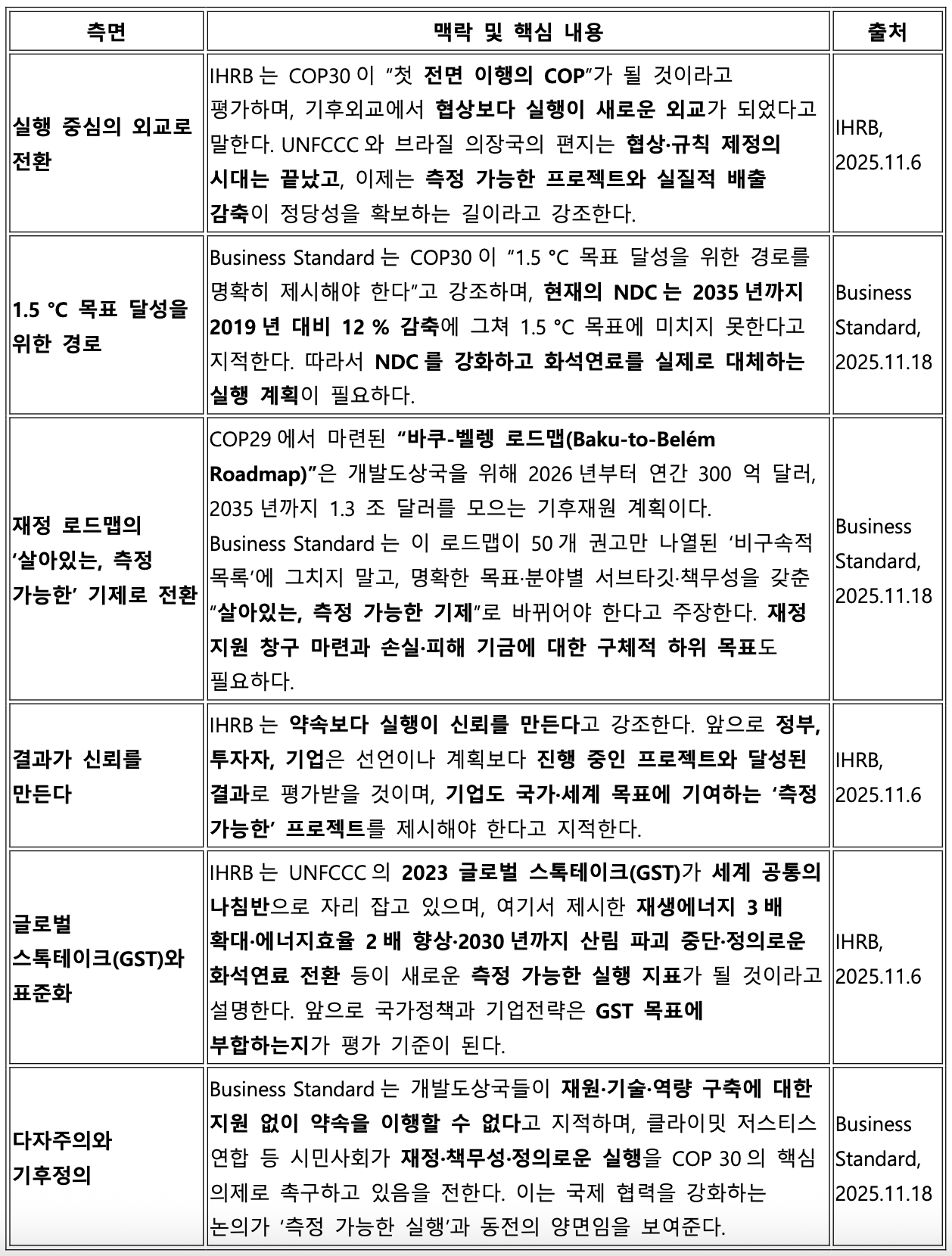
COP30의 의장국과 이번 유엔기후변화협약(UNFCCC)은 “첫 전면 이행의 COP가 될 것”이라는 평가를 한 바 있다. 아마존 밀림의 삼림 벌채(deforestration)에 대한 기금 조성에 대한 합의가 있었고, 우리나라 정부도 탈석탄동맹(PCAA)에 가입하였으며 이에 대한 이행 조치로 2040년까지 화력발전소 61기중 40기를 폐지하고 발전량 부족분을 신재생에너지로 대체하겠다는 계획을 언급한 바 있다. 한편 국내에서는, 2035 NDC의 발표에 즈음하여, 우리 정부가 제시한 탄소 감축 경로의 가혹함에 대한 다양한 의견이 제시되고 있어 앞으로도 본격적인 논의가 이루어질 것으로 보인다.
COP30에서도 논의된 아젠다 중, 국내외 전문가들의 기후변화 적응에 대한 실행력 제고가 필요하다는 의견의 연장선 상에서 ‘측정 가능한 실행’을 위한 제언을 하고자 한다. 제조 강국으로서의 한국 입장에서는 이번 COP30에서 주로 논의된 에너지믹스, 자연 보호 이외에 기후변화 적응 정책에 대한 고민도 필요해 보인다. 기후 기금의 조성, 글로벌 스톡테이크(GST)의 표준화에 대한 실행력을 담보할 수 있는 것은 결국 -다자주의와 기후정의 측면에서- 측정 가능한 실행 지표를 설정하여 이의 이행을 좀 더 빠른 주기로 점검하는 것이 필요하다는 것이 필자의 생각이다.
산업 공정 측면에서 본다면 국가 온실가스 배출량 통계의 품질 개선과 함께, 결국 배출권 거래제 등 탄소가격 정책의 강화가 필요하며 이를 레버리지로 한 기후 기술의 신속한 개발 및 도입을 위한 실제적 경제성의 부여가 필요하다. 따라서, 탄소중립 기술의 탄소 저감량을 제대로 인증·평가하기 위한 측정 기술 및 인프라 개발에 속도를 내야하는 시점이다.
|
|
|
박훈 고려대 오정 리질리언스 연구원 교수
*2025.11.24. 추가
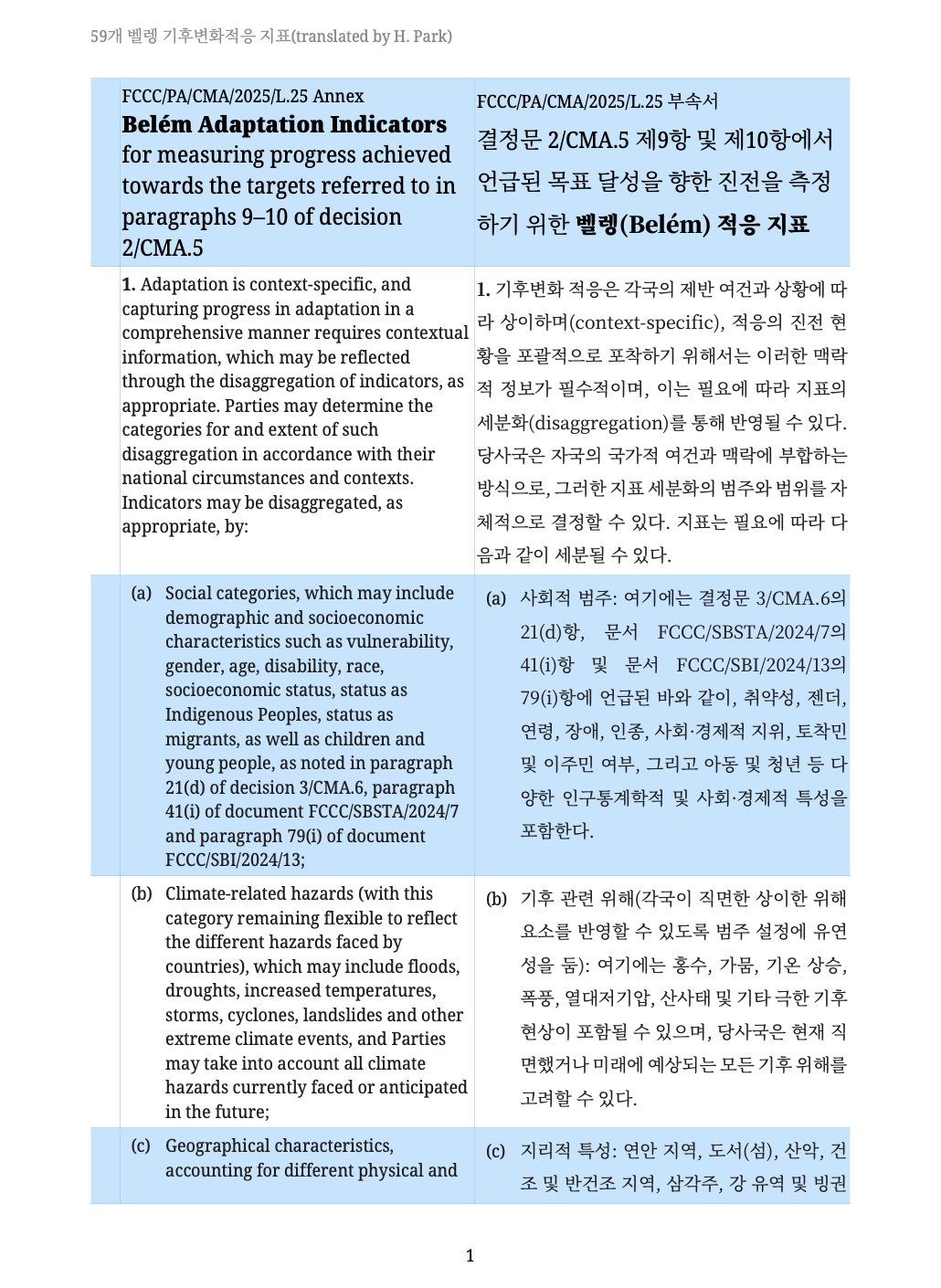
이번 유엔기후변화협약(UNFCCC) 제30차 당사국총회(COP30)에서 전문가들이 제출한 100개 기후변화적응지표 후보 중 59개가 최종 선정되었습니다. 우리말로 번역해서 영한대조표(아래 이미지. 전체는 총 15쪽. 아래 링크에서 다운로드 가능)를 만들었습니다.
(59개 벨렝 기후변화 적응 지표: 파일 전체 받기(총 15p)
|
|
|
(출처: Belém Adaptation Indicators for measuring progress achieved towards the targets referred to in paragraphs 9–10 of decision 2/CMA.5 (FCCC/PA/CMA/2025/L.25 Annex))
ecology@korea.ac.kr
|
|
|
예상욱 한양대 해양융합공학과 교수
*2025.11.23.
COP30은 적응 재원 확대와 1.5도 목표 이행 가속화에 합의했다는 점에서 여러 대외적인 악조건 아래에서도 기후위기 대응의 동력을 유지하였다데 의의가 있을것 같습니다. 아쉽게도 지구 온난화 억제에 가장 중요한 핵심 쟁점인 화석연료의 단계적 폐지를 명문화하지 못해 에너지 전환의 속도와 방향성을 분명히 제시하지 못했다는 한계가 있습니다. 이런 가운데 한국은 새 NDC 발표와 PPCA 가입으로 이전에 비해 큰 진전을 보였지만, 실제 감축 실현 가능성을 확보하고 재생에너지 전환·기후 적응 투자 확대 등 구체적 로드맵을 강화하는 것이 향후 과제입니다.
swyeh@hanyang.ac.kr
|
|
|
아래는 영국 사이언스미디어센터(UK SMC)에서 11월 21~23일 배포한 긴급 전문가 반응(RAPID REACTION)입니다. 엠바고는 없습니다. 이후 추가 코멘트는 SMC 홈페이지에서 확인할 수 있습니다. |
|
|
(23일 추가) Dr Nathan Johnson, Research Associate in Sustainable Energy Systems at Imperial College London, said:
“Keeping 1.5°C alive means phasing out fossil fuels and slashing deforestation this decade. Yet the COP30 text doesn’t mention ‘fossil fuels’ at all and refers to ‘deforestation’ just once. More finance for the poorest is welcome, but without a clear plan to wind down coal, oil and gas and stop forest loss – the principal drivers of warming – this deal sidesteps both the causes of and solutions to the crisis.”
(23일 추가) Dr Aline Soterroni, Senior Research Fellow in the Nature-based Solutions Initiative and Oxford Net Zero, University of Oxford, said:
“As a Brazilian scientist working on climate–nature linkages, it is disappointing to see a ‘forest COP’ in the Amazon advance without strong language on halting and reversing deforestation and forest degradation by 2030. The science is unequivocal: in tropical countries like Brazil, halting deforestation is essential for achieving net-zero emissions1. Globally, our terrestrial and ocean carbon sinks must be protected and restored; otherwise, reaching global net zero will be put at serious risk2.
“Beyond carbon, safeguarding forest ecosystems such as the Amazon — that is approaching a critical tipping point — is vital for maintaining key ecosystem services, including water regulation, which supports food production and renewable energy security. It is also a moral and ethical imperative. Deforestation destroys biodiversity, undermines ecosystem resilience, and harms local communities and Indigenous peoples, who have contributed the least to these crises yet bear their impacts most acutely.”
1 https://onlinelibrary.wiley.com/doi/10.1111/gcb.16984
2 https://netzeroclimate.org/publications/geological-net-zero-and-responsibility-for-the-protection-of-land-and-ocean-carbon-sinks/
(23일 추가) Prof Shaun Fitzgerald FREng, Director of the Centre for Climate Repair at the University of Cambridge, said:
“The final day of COP says a lot. The lack of progress on agreeing the path and crucially the timing on phasing out fossil fuels is terrible. 30 years of talking and just baby steps. We owe it to future generations to rethink the whole process because a system which requires all 190+ countries to agree on something hasn’t worked.”
(23일 추가) Dr Alaa Al Khourdajie, Research Fellow, Imperial College London, said:
“The text repeatedly asserts resolve to keep 1.5°C "within reach". However, our only chance for 1.5°C is now likely through overshoot, i.e. temporarily exceeding before returning, which already comes with huge feasibility challenges. Yet the outcome acknowledges a 2.3–2.5°C trajectory, risking even this overshoot-and-return scenario. Without binding requirements for immediate fossil fuel output reduction and increased mitigation action, we're choosing between accepting 2.3°C as permanent or attempting course correction so late that any overshoot becomes unnecessarily deep and prolonged (if return remains feasible at all), resulting in more irreversible climate impacts.
“While establishing a roadmap is positive for planning, "each country at its own pace" presents a fundamental tension with physical reality. The carbon budget is fixed and rapidly diminishing. Delay doesn't provide options, it eliminates them. If national pace is determined by economic convenience rather than physical constraints, every year without output cuts pushes the peak higher and makes return to 1.5°C less feasible, should we decide to attempt return at a later point.
“While NDCs have improved, aggregate ambition falls short of the 60% reduction by 2035 required for 1.5°C. Crucially, per the recent ICJ advisory opinion, NDCs aren't voluntary suggestions. Under Article 4(3) of the Paris Agreement, they must reflect states' "highest possible ambition." Setting targets that knowingly fail to align with temperature goals may constitute internationally wrongful conduct.
“COP30 was a diplomatic success (keeping the process alive, meeting funding targets), but a physical failure. We needed clear signals to enable managed overshoot with feasible return; we got an accelerator for voluntary measures that risks either permanent exceedance or unnecessarily severe overshoot.”
(23일 추가) Prof Alexandre Antonelli, Executive Director of Science at the Royal Botanic Gardens, Kew said:
"COP has fallen short of delivering an agreement that reflects what the science unequivocally demands. The path ahead is unmistakable: we must cut emissions, protect and restore nature, and follow the science. If we act together, we can still secure a liveable planet and the future of generations to come. As the COP President, Brazil did, however, deliver some meaningful progress. They introduced a clear and ambitious financing mechanism (the Tropical Forest Forever Facility) to safeguard the world’s tropical forests, and strengthened collaboration across the Global South to advance a fair and resilient bio-economy."
Prof Nathalie Seddon, Director of the Nature-based Solutions Initiative, Smith School for Enterprise and Environment, University of Oxford, said:
“I find it deeply troubling that a COP widely branded as a ‘forest COP’ and held in the Amazon region, has failed to deliver anything meaningful on forests. In the formal outcome, forests are largely confined to preamble language, with no roadmap for halting and reversing deforestation and forest degradation by 2030, and only very weak, voluntary references in the mitigation work programme. This falls far short of what the science tells us is urgently needed. Intact, biodiverse tropical forests play a critical role in stabilising the climate and protecting us from climate change impacts, yet they will only continue to do so, if they are protected, restored and governed in partnership with the Indigenous Peoples and local communities who care for them.
“Equally worrying is the absence of a clear, time-bound roadmap for a just phasing out fossil fuels. Without a rapid, orderly and equitable exit from coal, oil and gas, we won’t meet our climate goals, not least because we are effectively forcing the biosphere to shift from being a net absorber of greenhouse gases to a net source, as forests, wetlands and other ecosystems cross biophysical tipping points. The leadership shown by countries such as Colombia, which challenged the lack of fossil fuel phase-out language and forced the plenary to be suspended, stands in stark contrast to the timidity of the final text. It seems that the political mandate is there, but the plan is not. Until we have coupled roadmaps for ending deforestation and phasing out fossil fuels, grounded in rights and direct finance for those who safeguard ecosystems, we will remain off track for a safe and just future.”
Prof Michael Grubb, Professor of International Energy and Climate Change, University College London (UCL), said:
“The damp squib of outcome from COP30 has underlined that a focus on the negative – phasing out of fossil fuels - is fraught with political obstacles. Too many countries, including many developing countries, hope to profit from developing and selling fossil fuels. For the road to COP31, the focus must be balanced by equal attention to the positive – the huge economic potential of accelerating the energy transition, and ways to help countries around the world benefit from renewables and electrification.”
Dr Alan Dangour, Director of Climate and Health at Wellcome, says:
"I want to thank the Brazilian Presidency, Brazil Ministry of Health and UN Climate Change teams for their courage and determination to make progress at COP30 in extraordinarily difficult circumstances.
"UN Climate Conferences will always involve compromise and incremental progress while every country has to agree a final text.
"I am heartened to see the increased action at COP30 to protect human health as well as the much greater focus on the challenges that climate change brings to vulnerable communities around the world.
"The Belém Health Action Plan and the important decision on the Global Goal on Adaptation will ensure the inclusion of robust, evidence-based action and indicators on health that are vital to protect lives and livelihoods in the years ahead.
"Wellcome and our partners are committed to supporting climate and health solutions where they are most needed and this work continues at pace both outside climate conferences and as we look forward to COP31 next year in Türkiye and Australia. We will build on the important progress made in Brazil and ensure that science continues to deliver the solutions to protect health from climate change - our lives now depend on it."
Dr James Dyke, Associate Professor in Earth System Science, and Assistant Director of the Global Systems Institute at the University of Exeter, said:
“COP30 comes ten years after COP21’s achievement of the Paris Agreement, and its objective to limit warming to well-below 2°C. For the Paris Agreement to have had any chance of success, governments – particularly those in rich, industrialised nations - would have needed to accelerate the phase out of fossil fuels at the same time of phasing in the financial support for energy transitions in the Global South. Neither have happened.
“In 2024, industrial processes poured a record-breaking 37.4 billion tons of carbon dioxide into the atmosphere, while the amount of climate finance thus far promised is a fraction of what is needed. Despite the host’s best efforts, COP30 will not even be able to get nations to agree to fossil fuel phase out. This shameful outcome is the result of narrow self-interest and cynical politicking."
Professor Richard Betts MBE, Head of Climate Impacts Research at the Met Office Hadley Centre, and Chair in Climate Impacts at the University of Exeter, said:
“Holding this COP in the Amazon put the ongoing threat to tropical forests in the spotlight. With global warming set to exceed 1.5C in the next few years, forests will play a vital role as carbon sinks to help limit the extent of further warming and potentially reverse it in the long term. Continuing to study and protect them will be crucial."
Dr Steven Smith, expert in positive tipping points and exponential change at the University of Exeter, said:
“Before the COP process kicked off in Berlin 30 years ago, climate scientists already knew that a safe operating space for humanity depended on us rapidly transitioning away from fossil fuels – we needed to lower GHG emissions at least 60% by the 2020s. Instead, 30 COPs later, we’ve increased emissions by 60%.
“So, it would be easy to say the COP process has failed, forgetting how much worse things might have been without it. At COP 21, countries came together to agree to limit global warming to below 2oC, preferably 1.5oC. At COP 28, countries agreed to transition away from fossil fuels. Now, over 140 countries and sub-national governments covering over 90% of the world’s economies have carbon net zero targets. The rate of growth of emissions is slowing down, from 2% per year down to 0.6%. Emissions of the world’s worst polluters have peaked. A clean tech revolution is set to transform the world. This year, growth in solar and wind for electricity generation surpassed the total growth in electricity demand, which means fossil-fuelled electricity generation is now in structural decline.
“It is beyond disgraceful that a few countries could veto in the overall ‘cover decision’, the ‘Global Mutirão’, on the need to ‘transition away from fossil fuel’. But the battle to reach a final compromise text at Belem is not where the real war is being waged. This is between the world’s two economic giants, the USA and China, who are going all in on opposite energy futures, and not just for themselves. Both countries have ambitions to be the energy supplier to emerging countries and are building enormous energy exporting capacities – China with solar panels and batteries, and the USA with Liquid Natural Gas (LNG). As Ember’s Sam Butler-Sloss and Kingsmill Bond persuasively argue, China looks to have the winning hand as solar power continues to race ahead as the cheapest, fastest to deploy, and most versatile energy source in human history. For the three-quarters of the world that imports fossil fuels, renewable energy electrification is also the path to energy independence and security.”
Dr Jesse Abrams, Senior Research Fellow and one of the UK’s foremost experts in Physical Climate Risk at the University of Exeter, said:
“The removal of fossil fuel transition language from the COP30 draft represents a concerning reversal of the limited progress made at COP28. This backsliding comes at precisely the moment when our understanding of climate risks shows we have less room for delay than previously thought.
“We’re already seeing floods, droughts, and extreme events intensifying globally, while systemic threats from potential tipping points in Earth systems loom larger. Current risk assessments systematically underestimate these dangers by failing to account for how climate impacts cascade through economic networks and can trigger irreversible changes in systems like ocean circulation.
“As geopolitical fragmentation intensifies, particularly with shifts in US climate leadership, we’re likely to see climate action increasingly driven by coalitions of willing nations and industries rather than unified global frameworks. This diplomatic deadlock doesn’t pause the physical climate system. Each year of continued fossil fuel dependence locks in greater exposure to extreme events while increasing the probability of crossing irreversible thresholds - with profound implications for global security and economic stability.”
Dr Martina Egedusevic, an expert in nature-based solutions and risk management at the University of Exeter, said:
“COP30 will be remembered as the moment global leadership simply evaporated. At a time when extreme heat, catastrophic floods and wildfires are setting new records every year, negotiators still could not summon the basic courage to stand up to fossil-fuel interests. This is not a diplomatic setback. It is climate malpractice. Wealthy nations and petrostates have knowingly chosen political convenience over planetary survival, allowing the crisis to accelerate while pretending their watered-down commitments are progress. History will not be kind to those who had the power to act and instead chose delay, denial and self-preservation.”
Dr Marcos Oliveira Jr., Research Impact Fellow at the University of Exeter, said:
"COP30 marked significant progress in the global governance of information integrity. For the first time in the history of COP, the topic of information integrity was formally included in the official agenda, with two dedicated thematic days.
“The COP30 Presidency also appointed a Special Envoy for Information Integrity, underscoring the strategic relevance of the topic. One of the main outcomes was the mobilization of a Global Initiative for Information Integrity on Climate Change, accompanied by the launch of the ‘Declaration on Information Integrity on Climate Change’ on Wednesday, 12 November. By endorsing the declaration, countries committed to implementing strategies aimed at addressing climate misinformation, strengthening information ecosystems, and promoting the dissemination of accurate and reliable climate-related knowledge."
Prof Daniela Schmidt, Professor of Earth Sciences, University of Bristol, said:
“We are currently on the path of warming with devastating consequences for many regions, peoples, economies, and ecosystems. This COP has not changed this path, has not increased speed or ambition.
“How do we pick ourselves up and, if the governments don’t increase action, bring this to the places where we work, the cities where we live and communities where we are home? Because this is where the action must be when governments fail. No action is no option as too many communities are deeply vulnerable to climate change. While at the moment we are focused on floods, hurricanes, droughts and term these as extreme events, they will become the norm and combine with increases to food prices, displacement and increasing loss of livelihood. Climate change will not stop because we do not acknowledge what needs to be done.”
Dr Robin Lamboll, Research Fellow at Imperial College London, said:
“This COP has been deeply disappointing. It claimed to be a COP of action, but all comments on fossil fuels, and even most comments on deforestation that this COP was supposed to highlight, have been removed from the final text. Being literally on fire at one point was a fitting metaphor. Even the absence of the USA, the hoped for "ambition by the ambitious" failed to materialise, with many countries falling behind on their NDC updates.
“Nonetheless, it has provided a few points of light. The reaffirmation of the importance of keeping 1.5C in reach, implicitly even when it may be temporarily exceeded, is good, but relatively toothless. The need for more precision on how to limit warming and who would pay for any carbon removal would be essential going forwards. The text is also relatively good for indigenous rights, including the first acknowledgement of tribes in voluntary isolation. It also featured distinct progress on loss and damages.”
Prof Simon Lewis, Professor of Global Change Science, University College London, said:
“Bitterly disappointing. That all countries cannot agree to even plan a roadmap for a just transition to phase out fossil fuel is a failure.
“The balance of geopolitical power in the world is such that we can call it a ‘non-polar world’, where climate change ravages the planet, yet no country or group of countries commands sufficient power to collectively tackle the problem.
“The COP30 presidency announced two roadmaps to curb fossil fuel use and to halt deforestation, but these are coalitions willing, not binding agreements.
“The good that came out of COP, such as the new scheme to protect tropical forest, the Tropical Forest Forever Facility, $2.5 billion for protecting Congo Basin Forests, and $1.8 billion for forest-dependent indigenous and local communities, happened outside the main process. Expect more of this a non-polar world.”
Bob Ward, policy and communications director at the Grantham Research Institute on Climate Change and the Environment at the London School of Economics and Political Science, said:
“There were many positive outcomes from this summit, such as the launch of the new initiative on the Tropical Forests Forever Facility to tackle deforestation. However, the lack of an explicit reference in the final decision to the need for a transition plan for the phase out of fossil fuels shows the unfortunate and harmful influence of major producers of oil, coal and gas who put their short-term financial interests ahead of the best interests of current and future generations around the world.
“In addition, the COP process demonstrably failed in dealing with the indicators of progress on the global goal on adaptation, with negotiators butchering the list carefully put together by experts over the past two years, rendering the final list deeply flawed.”
Dr Nina Seega, Director of the Centre of Sustainable Finance at the University of Cambridge’s Institute for Sustainability Leadership (CISL), said
"The outcome of COP30 hinged on fossil fuels and finance. The nature of Mutirao compromise meant that a reference to fossil fuels did not make it into the final text, but rather the Presidency announced two roadmaps – one for transitioning away from fossil fuels and one for halting and reversing deforestation. A climate finance work programme was announced, but situating the adaptation goal within $300bn goal creates a zero-sum dynamic between mitigation and adaptation funding - a false choice that undermines comprehensive climate action.
“The question leaving COP30 is whether that would be enough to prevent millions more from enduring the simultaneous catastrophes of heat, flood, and fire that Belém itself demonstrated so powerfully."
Eliot Whittington, Executive Director of the University of Cambridge’s Institute for Sustainability Leadership (CISL) said:
"COP30 in Belem was a story of slow progress and complicated politics struggling to catch up with growing green economy momentum. We saw the launch of new innovative financing mechanisms to protect forests, and an unprecedented movement of countries against fossil fuels - but the final text which did include clarifications and strengthening of many details around international climate action was hemmed in with weak, obscure language and was greeted with opposition by many countries questioning what was actually agreed.
"This is not a failing or weak multilateral process - it was energetic and dynamic and controversial. But it given the diversity of perspectives in the international community it is not delivering the necessary speed of progress on climate action."
Declared interests
Simon Lewis: “no competing interests.”
Robin Lamboll: “No interests to declare.”
Daniela Schmidt: “No competing interests.”
For all other experts, no reply to our request for DOIs was received. |
|
|
아래는 호주 사이언스미디어센터(AusSMC)에서 11월 23일 배포한 전문가 반응(EXPERT REACTION)입니다. 엠바고는 없습니다. 이후 추가 코멘트는 SMC 홈페이지에서 확인할 수 있습니다. |
|
|
Dr Changlong Wang (he/him) is Australian Research Council Industry Fellow, Monash University; Task Manager, IEA Hydrogen TCP Task 52 (“Hydrogen for Iron/Steelmaking”)
“To me, COP30 keeps the door open, but it did not slam it all the way shut on business-as-usual. The real test will be how governments, industry and investors mobilise in 2026 and beyond.
COP30’s final Mutirão decision offers a mixture of needed clarity and lingering gaps. It is positive that Parties reaffirmed the Paris temperature goal (including pursuing efforts to limit warming to 1.5 °C and minimising any overshoot) and placed renewed emphasis on adaptation and support for vulnerable countries. This matters because it signals that science-based thresholds remain the anchor for global action. For those of us working on the green-industrial transition, such as hydrogen-based iron and steelmaking, the stronger focus on implementation, infrastructure and transition pathways is welcome, even if the overall outcome still reflects both forward momentum and missed opportunities.
On the downside, the summit fell short of securing a concrete roadmap for phasing out fossil fuels, a key gap given the urgency of industrial decarbonisation. Without binding agreements to shift away from coal, oil and gas, ambitions around hydrogen, green iron and green ammonia risk being undermined by a lack of transformational momentum.
In my view, the next crucial step is to translate the adaptation-finance pledges and infrastructure frameworks into accelerated industrial deployment: first-of-a-kind green iron projects, scaled hydrogen production and supply-chain investments. If COP30 has given us anything, it’s a reaffirmation that the fight is still live, but now the clock is ticking. The science is clear: deployment at industrial scale must ramp up in this decade."
I lead research projects funded by government and industry in the green-steel and renewable-energy sectors. I serve on advisory panels for Australian Energy Week but have no paid lobbying role and no direct fossil-fuel industry ties.
--------------------------------------
Stefan Trueck is Director Transforming Energy Markets, ARC Future Fellow, and Professor of Business Analytics, Macquarie University
"COP30 delivered some meaningful steps forward, particularly on the adaptation front. The decision to significantly scale up adaptation finance and strengthen the new Climate Finance Work Program is an important outcome. Many climate-vulnerable countries have been calling for predictable, long-term support, and this COP finally produced clearer commitments and a framework that could help turn pledges into actual delivery. If implemented effectively, these measures will improve resilience planning, disaster preparedness, and the capacity of developing nations to cope with escalating climate impacts.
However, progress on mitigation was noticeably weaker and negotiators again fell short of agreeing to a concrete pathway for phasing out fossil fuels. This reflects a broader reality: despite three decades of global climate negotiations since the first COP in 1995, global CO₂ emissions have risen by more than 50% over the past 25 years, and many economies remain deeply dependent on coal, oil, and gas for growth and employment. While the final text acknowledges the need for accelerated action, it offers little that would materially bend the global emissions curve in the near term.
As a result, COP30 sends mixed signals—promising steps on adaptation, but insufficient momentum on the urgent task of reducing fossil fuel use."
Stefan has declared that he has no conflicts of interest.
--------------------------------------
Andrew King (he/him) is an ARC Future Fellow, Associate Professor in Climate Science at the University of Melbourne and Chief Investigator, ARC Centre of Excellence for the Weather of the 21st Century
"It's hard not to feel disappointed. Another COP goes by and we're not seeing the necessary commitments to greatly reduce fossil fuel emissions. Even while there is recognition of the need to reduce emissions, many countries, Australia included, are expanding fossil fuel projects. Every tonne of greenhouse gases emitted adds to global warming and increases the scale of the climate crisis. We remain on a path of high emissions and worsening climate impacts."
Andrew has not declared any conflicts of interest.
--------------------------------------
Johanna Nalau is Associate Professor, Climate Adaptation, Griffith University
"At this COP, the Global Goal on Adaptation (GGA) was a major negotiation item, with many different suggestions on what should be included, and which indicators for adaptation were going to be acceptable to all the Parties. The Conference of the Parties serving as the meeting of Parties to the Paris Agreement(CMA), considered close to 100 indicators, discussed them, and produced a revised list that is forward looking. This list is in line with the needs of the Global Stocktake (GST) in assessing the gap between the current state of adaptation and a future desirable state. The proposal includes an Annex with 59 indicators that build on the UAE-Belem technical work program on adaptation indicators. These indicators collectively cover 11 targets of the GGA, including water, food, health, ecosystems and biodiversity, infrastructure and human settlements, poverty reduction and livelihoods, and cultural heritage, and matters relating to assessing, planning, implementing, and monitoring climate adaptation. The adoption of these indicators is a major outcome as it sets, for the first time ever, clear benchmarks on how to evaluate global progress on adaptation."
Johanna is Coordinating Lead Author, Intergovernmental Panel on Climate Change, 7th Assessment Report, Working Group II.
--------------------------------------
Martina Linnenluecke is Professor of Environmental Finance and Director, Centre for Climate Risk and Resilience, UTS Business School, University of Technology Sydney
"COP30 left the core issue of climate change largely untouched: stringent pledges to phase out fossil fuels at a rapid pace.
Despite the growing global consensus that a low-carbon transition is inevitable, many of the world’s largest fossil-fuel producing nations oppose a phase out. The final agreement omitted explicit language on phasing out coal, oil and gas, which is a clear signal that major producers retain considerable influence
More than 80 countries had called for a roadmap to accelerate the shift away from coal, oil and gas, but this was blocked by major producer nations. As a result, transition risk for carbon-dependent firms remains high because policy direction is still uncertain.
For business and finance, the signal is mixed: adaptation and resilience efforts will attract increasing investment, while the pace and direction of the low carbon transition remain contested.
Governments agreed to triple international funding for adaptation, but this remains well below what vulnerable communities require to cope with escalating climate risks. The agreement to establish a just transition mechanism is a positive acknowledgement.
Science is clear that without decisive action on fossil fuels, adaptation alone cannot prevent mounting economic losses and severe social disruption. COP30 keeps the process alive but the pace is still too slow for a safe climate future. The hope is that the the transition can be accelerated at local levels – with private capital, households and communities shifting away from high-carbon assets."
Martina declared that she has no conflicts of interest.
--------------------------------------
Associate Professor Paul Read, Charles Sturt University
Co-director, Future Emergency Resilience Network
"COP30. Clock the 30 in its name - a full 30 years of annual talks tracking a global crisis that pits our economic systems against the very real boundaries of the planet. Of all nine boundaries specified by the Stockholm Resilience Centre, we have surpassed seven, three of the most urgent being climate change, species extinction and pollution. Compare the lack of action at COP over the first 30 years to the incredible global cooperation attained in response to the hole in the ozone layer. Discovered in 1985, the world agreed on action on ozone within four years - the Montreal Protocol of 1989 was lauded as a signal to the world that we could collectively, as a species, respond to global threats with vigour and wisdom.
Not so in 2025, when COP30 spurred vigorous opposition to action from 80 petrochemical states emboldened by Trump's withdrawal from the Paris Agreement.. Multiple recent surveys of IPCC scientists demonstrate consensus on at least 3 degrees' anomalous increase by 2100, although we and many others carefully watch models that suggest we could hit 4 degrees by 2040. This would, according to the global reinsurance industry, collapse the entire economic system. COP30 has at least agreed to triple adaptation funds and urge nations to voluntarily manage the transition away from fossil fuels. This won't be enough. We need rapid mitigation as well as adaptation."
Paul has not declared any conflicts of interest.
--------------------------------------
Kate Dooley, Senior Research Fellow, University of Melbourne
"The headline from the UN climate talks is clear: countries failed to agree on concrete action to phase out fossil fuels. The ‘Amazon COP’ also fell short on forests. For two weeks, negotiations over a ‘Forest Roadmap’—intended to close the growing gap between global goals to halt and reverse forest loss by 2030 and the weak commitments from countries—were at the centre of a major stand-off. With no real outcome on forests from the negotiations, Brazil has now announced its own Forest Roadmap as COP President. It remains to be seen whether this will gain traction and bring all forest-loss countries, including those facing degradation from industrial logging, to the table."
Paid and unpaid advisory positions to The Minderoo Foundation and Climate Integrity..
--------------------------------------
Kathryn Bowen is Professor and Deputy Director, Melbourne Climate Futures, Professor of Environment, Climate and Global Health,
Director, WHO Collaborating Centre on Climate Change and Health - Research and Policy and Lead Author, IPCC Seventh Assessment Report, Human Health and Wellbeing Chapter
"COP30 has finished up in Belem with no new fossil-fuel commitments, a weakening of measuring adaptation progress, and pushing out the ambition for adaptation funding to 5 years beyond what was previously agreed (now 2035).
In more promising outcomes, countries will have the first-ever international conference on fossil fuel phase out in April, 2026, an attempt to restore some sense of a ‘roadmap’ to this critical issue. Next year’s COP will be an intriguing display of diplomatic nous, given the unusual hosting of the COP in Turkey, with Australia to take on the role of ‘President of Negotiations’. Given the typical challenge of one country running the entirety of a COP process, splitting up these roles does not bode well for heightened ambition and consensus-making. But who knows!!
The climate crisis is a health crisis - every day we see this playing out, whether through death and injury from cyclones, or floods or heat — and until we see a greater coming together of countries within these tricky multilateral processes we are going to continue to see the death toll rise, with those from the global majority taking the hit. "
I receive funding support from DFAT, Wellcome, World Health Organization, World Bank, DCCEEW (for IPCC related business), Green Climate Fund. I advise the Climate and Health Alliance and sit on the committee of management of the Port Philip EcoCentre.
--------------------------------------
Siobhan McDonnell is Associate Professor at the Crawford School of Public Policy at the Australian National University (ANU). She is also a lead climate negotiator and advisor for Vanuatu. Siobhan is still in Brazil and attended the closing plenary
"There is room for improvement and much more urgent action needed to keep 1.5 within reach.
This COP is weak on mitigation ambition. The Mitigation Work programme decision, in particular is weak. Particular groups also worked to prevent any reference to the Global Stocktake, and the Global Stocktake energy package (paragraph 28 of the GST decision text) that includes commitments to transition away from fossil fuels and inefficient fossil fuel subsidies.
It was important to get an outcome at this COP, and at this moment in multilateralism. Particularly given the United States recent decision to exit the Paris Agreement for a second time. The remaining 194 States who are Parties to the Paris Agreement needed to ensure that there was an outcome.
The outcome on Just Transition is good. The statement by the Brazil COP President on his announcement of a roadmap to transition away from fossil fuels is also a welcome announcement. But we need to be able to discuss these issues of fossil fuel transition and the GST within the negotiation rooms, and this means a discussion of the GST and the GST energy package.
Looking ahead I welcome the Turkey/ Australia Presidency Agreement and I look forward to COP31 delivering on mitigation ambition. The top priority for the Vanuatu and the Pacific will be keeping 1.5 Alive."
Siobhan is a lead negotiator and advisor on climate for Vanuatu.
--------------------------------------
Arthur Wyns is a research fellow at the University of Melbourne and a former advisor to the COP28 presidency
“I've been going to COPs for a decade, but this was by far the most difficult one. Not only did we face floods, fires, and extreme heat, the geopolitics was really stacked against us in Brazil. In that context, the outcomes from COP30 still managed to build powerful momentum on the need to phase out fossil fuels, with over 80 countries supporting a global roadmap to transition away from fossil fuel.
The COP30 outcomes are a sign that we are moving away from negotiating global consensus statements - which often end up with the lowest common denominator - and instead are moving into the implementation phase of the Paris Agreement.
Australia and Türkiye now have a big job ahead of them; they will have to shepherd a growing 'coalition of the willing' ready to rapidly phase out fossil fuels, while navigating the growing tension between those countries that are scaling up renewables and those that remain deeply dependent on the fossil fuel economy."
Arthur is a former employee of the Australian Government and a former employee of the UAE Government. He has received consulting fees from WHO, World Bank and UNDP.
--------------------------------------
Professor Jacqueline Peel is Redmond Barry Distinguished Professor and Laureate Fellow, University of Melbourne and an expert in the field of environmental and climate change law
"This COP on the edge of the Amazon showed that international climate cooperation lives on, even without the US. It dealt with all the hard, real-world challenges of implementation - fossil fuels, finance, just transition and trade - and on some took only small steps, not aligned with the urgency the science and humanity needs. But in a rapidly warming world, every issue is a climate issue and in dealing with them collectively COP30 saw that the world mostly remains in the same tent, even one that is flooded, fire-affected, hot and chaotic."
Jacqueline has declared that she has no conflicts of interest.
--------------------------------------
Professor Matthew Harrison FTSE is Climate Resilience Leader in the Tasmanian Institute of Agriculture, University of Tasmania
"It was great to see that the climate funding goal has tripled, as that will help accelerate climate change adaptation. I was disappointed on the lack of detail about phasing out fossil fuels. It is unequivocal that fossil fuels underpin the climate crisis, yet their use continues, and in many nations is increasing. The $120 billion COP30 pledge for climate change adaptation is a teaspoon in the ocean of $7 trillion subsidies that fossil fuel industries receive each year. Surely diverting some of these subsidies would help reduce our greenhouse gas emissions and encourage climate resilience?"
Matthew declared that he has no conflicts of interest.
--------------------------------------
Professor Amy Cutter-Mackenzie-Knowles is Executive Dean, Faculty of Education, Southern Cross University, Australia + Research Leader, Sustainability, Environment, and the Arts in Education (SEAE) Research Centre.
"COP30 has unequivocally declared that "Education is at the core of climate resilience.” Climate change education is not merely a priority; it stands as the greatest moral imperative of the 21st century. This revelation isn’t new. The United Nations has long advocated for environmental, sustainability, and climate change education as crucial solutions to the pressing threat of anthropogenic climate change. Yet, amid these bold international declarations, we face a stark reality: the courage to actualise these ideals at the national level is glaringly absent.
This dilemma brings us back to a fundamental question: What is education for? In education systems driven by capitalist ideals, climate change education is frequently relegated to the bottom of the priority list. What we need is not just a minor adjustment; humanity demands nothing less than a radical transformation of our educational frameworks. It is time to rise to the challenge and courageously redefine education. As Angela Davis once said we can ‘no longer accept the things’ we cannot change. We must change ‘the things we cannot accept.’"
Amy has not declared any conflicts of interest.
--------------------------------------
Professor Esteban Marcellin, Director of the UQ Biosustainability Hub
"COP30, the 30th United Nations Climate Change Conference held in Brazil, represented a step forward in global climate governance. It was the first climate summit to formally acknowledge that the temperature goal of the Paris Agreement will not be achieved. Although stark, this recognition created a more honest and constructive negotiation environment. By accepting that current efforts are insufficient, the focus shifted from aspirational rhetoric toward realistic implementation, resulting in a more grounded and solutions-oriented summit.
Hosting COP30 in Belém at the heart of the Amazon placed ecosystems, Indigenous stewardship and biodiversity at the centre of the global agenda. It highlighted that effective climate action depends on integrating environmental, social and economic considerations. This perspective broadened the scope of negotiation and encouraged parties to pursue climate strategies that deliver benefits for nature as well as sustainable development."
Note: This is an extract of a longer Opinion Piece that will be published on UQ News tomorrow.
Esteban has not declared any conflicts of interest.
--------------------------------------
Michelle Isles is Chief Executive Officer Climate and Health Alliance
“Australia’s leadership critical in 2026 to safeguard health and survival under 1.5 degrees with a disappointing end to the “implementation COP” in Belém".
Climate adaptation finance
“Amid extreme heat, floods and a fire, delegates experienced life on the equator under climate and health stress. While the COP30 agreement to triple adaptation finance by 2035 is a positive step, pushing out the delivery date compared to the 2030 timeline requested by developing countries means many more people will suffer as healthcare systems, homes and livelihoods are pushed to the limit”.
Fossil fuel transition
“We were buoyed to see Australia join 80 countries to support a Fossil Fuel Phase Out Roadmap and 23 countries to support Columbia’s proposal for the Belem Declaration on the Transition Away from Fossil Fuels. The declaration reaffirms determination to work collectively towards a just, orderly and equitable transition away from fossil fuels, aligned with pathways consistent with limiting the temperature rise to 1.5.
Australia will play an important role in 2026 to bring these commitments to the COP negotiating table. Governments urgently need to phase out fossil fuels - the primary driver of climate change - to avoid irreversible tipping points and to safeguard health. Australia is extremely vulnerable to climate impacts, our health systems are not prepared for current and future shocks and stressors and our Pacific neighbours need a fossil fuel phase out to ensure their survival”.
Just Transition
“We commend positive progress on the just transition work program including a mechanism for implementation with governments recognising the importance of protecting the human right to health and a clean, healthy and sustainable environment in just transitions”.
The Australian Government’s DCCEEW provided a travel grant to enable CAHA to attend the COP in Belem.
|
|
|
아래는 스페인 사이언스미디어센터(SMC Spain)에서 11월 22일 배포한 전문가 반응(EXPERT REACTION)입니다. 엠바고는 없습니다. 이후 추가 코멘트는 SMC 홈페이지에서 확인할 수 있습니다. |
|
|
Alicia Pérez-Porro
Marine biologist, responsible for policy interaction and institutional relations at the Centre for Ecological Research and Forestry Applications (CREAF) presente in Belém (Brazil)
COP30 was supposed to be the COP of adaptation, and all of us who work in this field are leaving Belém with mixed feelings.
On the one hand, we have financing. It is true that it has been agreed to triple the funding allocated to adaptation, but there is a catch to this decision. It has not been agreed that countries will contribute more funding to climate action, i.e. public contributions to climate action will not be tripled; what has been agreed is that the percentage of the funding approved in Baku during COP29 will be increased for adaptation. Although this is good news in general terms, the reality is that mitigation currently accounts for 80% of funding, and tripling the adaptation budget is only a stopgap measure because what is really needed is to triple public funding for adaptation.
On the other hand, we have the Global Goal on Adaptation (GGA). One of the central themes of the discussions on the GGA has been adaptation indicators. We ended COP29 in Baku with a proposed list of 100 indicators that measured, for example, the number of countries that integrated climate adaptation measures into their national plans or the proportion of a country's territory dedicated to agri-food production that uses practices and technologies relevant to climate adaptation (to cite just a couple of examples). Today we ended COP30 with the adoption of a reduced list of 59 indicators and with the discontent of Latin American countries, the EU and the African bloc, among others, who consider that this list does not reflect the realities of many countries, mainly those in the developing world. The African bloc went further and called for the current indicators to be blocked, given their concern that they would be pressured to spend more of their own governments' scarce funds on adaptation, and called for the creation of a specific working group and the transfer of its approval to COP32, i.e. postponing the decision for two years.
But I choose to side with the words of Josep Garriga, a great connoisseur of negotiations with 18 COPs behind him, who says that "in climate change, a defeat can be a victory; there would never have been the Paris Agreement without the failure of COP15 in Copenhagen".
Conflicto de interés: forma parte del comité asesor del SMC España.
Alejandro Caparrós
Professor of Economics at Durham University (United Kingdom), Research Professor at the Spanish National Research Council (CSIC) and Lead Author of the International Cooperation chapter of the IPCC's AR6
The Belém summit has left us with two clear messages.
Firstly, the old leaders are no longer leading and the new ones are not yet in a position to take the reins. Climate negotiations have been led by the European Union and the US over the last few decades, with notable successes when they have pulled in the same direction, as in Kyoto and Paris. The US did not send a delegation to Brazil, and a few days ago the EU announced a red line – the agreement had to expressly mention a path to abandon fossil fuels – which it crossed without hesitation by accepting an agreement with no mention of such a path. On the other hand, in recent months China seemed called upon to fill the leadership vacuum left by the old leaders. Not yet, although its time will come. Although it is no longer really a developing country, it remains aligned with developing countries that have secured a commitment to increase funding for adaptation in the most vulnerable countries. The commitment is modest, but probably more important than the inclusion or exclusion of a reference to fossil fuels with which the EU, the UK and other countries have sought to lead the negotiations.
Second. The time has come to space out the COPs, with one meeting every two years, or two meetings every five years, as Switzerland recently suggested. The loose ends of the Paris Agreement have been tied up and we do not need new declarations; we need to implement the existing agreements. The irrelevance of this COP in the media has been remarkable. The pantomime of last-minute negotiations to save the planet cannot be repeated every year, or it will cease to be credible.
The author has not responded to our request to declare conflicts of interest
Carlos de Miguel Perales
Environmental Lawyer and Lecturer of Civil and Environmental Law at ICADE Law School (Comillas Pontifical University)
Noteworthy positive points include the agreement to accelerate the fight against climate change, the review of trade barriers related to climate change, and tripling funding for developing countries to cope with extreme weather events.
On the negative side, the lack of agreement on the phase-out of fossil fuels undoubtedly stands out. Among other things, it shows the limits of the EU's leadership in the fight against climate change.
Two conclusions can be drawn at this point:
- As usual, the results are less than expected, but progress is still being made, albeit slowly.
- The fight against climate change continues to advance even without the US.
The author has declared they have no conflicts of interest
|
|
|
아래는 뉴질랜드 사이언스미디어센터(NZ SMC)에서 11월 23일 배포한 전문가 반응(EXPERT REACTION)입니다. 엠바고는 없습니다. 이후 추가 코멘트는 SMC 홈페이지에서 확인할 수 있습니다. |
|
|
Prof Bronwyn Hayward, Professor of Political Science and International Relations, University of Canterbury, comments:
"New Zealand faces a stark choice: will we back a few large oil states who continue to block progress or will we support the Pacific and our traditional allies?
"At COP 30 New Zealand failed to join the call by the United Kingdom, Ireland, Pacific nations (including Fiji and Vanuatu), and over 83 other countries led by Colombia who pressed for a global plan to transition away from fossil fuels.
"Hard questions should be asked about why we found ourselves aligned by default with states like Saudi Arabia and Russia, who repeatedly veto attempts at collective climate progress?
"Calls are mounting for reform of the COP process, which currently enables a single individual country to veto collective decisions. One of these reforms might already be found in the compromise that was achieved over who hosts the next COP meeting.
"The Republic of Türkiye’s had insisted it should chair the next COP, despite reportedly not having the support of most nations. The stalemate was broken with an agreement that Türkiye would be the host nation but the lead negotiator would come from Australia (Chris Bowen) with a pre-COP meeting hosted by the Pacific.
"The Pacific small island states have been masterful in keeping a focus on the impact of 1.5 degrees of warming and it will be important that New Zealand supports the Pacific to use this new arrangement in effective ways to press their case.
"Meanwhile, agreement to finance adaptation and recognise indicators of effective adaptation was achieved at this COP but only within current budget plans. Given the billions of dollars that a single major storm event can already cost a country, adaptation progress is despairing slow
"And yet, 'We are still here' as Brazil’s Environment & Climate Minister Marina Silva said in her closing words at COP today. She is well placed to reflect on the importance of diplomatic and civil society struggles to achieve international agreements since Brazil's first global Earth Summit in Rio De Janeiro back in 1992. Her life experiences as a deforestation activist, union worker and politician have symbolised the high hopes some had for a Brazil COP presidency.
"While the power bloc of the oil states, unchecked by the USA and/or China, has slowed global progress, for New Zealand the choice is more stark: will we back the Pacific and press for real progress or join a few nations who continue to block practical and meaningful climate action?
"While the cost of living is a real and immediate problem for many nations, more and more governments are realising that if they fail to act to protect their communities from the costs and loss of life involved climate disasters they will also be judged very harshly by voters."
Conflict of interest statement: "Prof Bronwyn Hayward is a Professor of Political Science and International Relations at UC, and was a co convenor of Adaptation Futures 2025. She is a Review Editor for the forthcoming IPCC Special Report on Cities and Infrastructure and has served in a variety of roles in the last round of IPCC reports. No conflicts."
AMENDED Dr Cathrine Dyer, Lecturer in Climate Change, Victoria University of Wellington, comments:
"As the host of COP30, Brazil cast the summit as a ‘make or break moment’ for international cooperation on climate action.
"As the summit winds down with no formal agreement on a roadmap for phasing out fossil fuels, the response has been made clear. For the moment at least, international cooperation on climate action has been effectively neutered by petro-states supported by a widespread delusion that ‘business-as-usual’ can be sustained.
"In 30 years of international COP meetings, an agreement to reduce the use of coal, oil and gas has never been struck. It’s as if the world believes that climate change can be tackled by talking about it, while ignoring its primary causes.
"An energy transition requires that renewable energy replace fossil fuels. Without the broad application of policy constraints on the production and use of fossil fuels, additional cheap renewable energy risks becoming a catalyst for technological sprawl, igniting demand for more and more.
"The agreement reached at COP30 saw success in the adoption of a rights-based ‘Just Transition Mechanism’ and increased funding for Adaptation. While still critically under-funded, a specific focus on adaptation is necessary as climate funding typically focuses on more commercially attractive mitigation projects, where profit is available. No agreement on additional funding for loss and damage or a roadmap for delivering the new collective quantified goal (NCQG) on climate finance were achieved.
"In making space for community-based and indigenous knowledge, Brazil got one thing right. Now is the time to grow flourishing community conversations, connections, and grassroots action, following the lead of Indigenous people who refused to be sidelined at COP30. The transformations required to effectively address climate change are unlikely to emerge from established power."
Conflict of interest statement: "I declare that I have no conflicts of interest to disclose."
Dr Nathan Cooper, Associate Professor of Law, University of Waikato, comments:
"Despite failing to address deforestation or critical minerals, this deal represents some progress. It acknowledges the need for a ‘just transition’ to support vulnerable workers, it commits to make much more money available to developing countries for climate adaptation. But this is still incremental progress. What is really needed is a step change, a quick acceleration to phase down fossil fuels so that the pace of response to climate change starts to match the scale of the challenge.
"At the end of COP30, the multilateralism of the Paris Agreement remains just about intact. But there is still too little ambition for effective change, especially among rich nations and major fossil fuel producers.
"Meanwhile, countries including New Zealand continue to undermine effective action on climate change by setting Nationally Determined Contributions (emissions reduction commitments) that are not science-aligned and that, collectively, won’t achieve even close to the 1.5 degrees target, despite their legal commitment to do so."
Conflict of interest statement: "No conflict of interest."
Dr Priscila Besen, Senior Lecturer in Sustainable Architecture, Auckland University of Technology, comments:
"There were high expectations for this COP, with its setting in the Amazon, but the final text fell short of the ambitious promises that opened the summit. While it was encouraging to see adaptation receive greater attention — with COP30 adopting a call to triple adaptation finance by 2035 — the summit failed to directly confront the root causes of the climate crisis. There were expectations of a clearer roadmap to transition away from fossil fuels and end deforestation, yet these crucial elements were absent from the final text, due to disagreements among countries. Approximately 90 countries demonstrated their support for the roadmaps, and the presidency said they will still develop these post-COP, so there is still hope that this will be done later. The other bad news for Aotearoa New Zealand was that COP31’s host country will be Turkey, not Australia, as we were hoping.
"On a more positive note, I was pleased to see this COP make greater efforts to include diverse groups and boost civil society participation, with greater participation than in previous years. The overall outcome feels like a step back from what is urgently needed, but overall, it is still positive to see global collaboration in a year marked by many conflicts."
Conflict of interest statement: "No conflict of interest relating to this statement." |
|
|
한국과학기술미디어센터(SMCK) 소개
한국과학기술미디어센터는 근거 기반의 과학 정보를 언론에 제공하는, 과학계와 미디어 사이의 다리 역할을 하는 독립 비영리 조직입니다. 잘못된 정보와 가짜 뉴스가 넘쳐나는 세상에서, 제대로 된 전문가의 해설과 의견을 빠르고 다양하게 기자들에게 제시하고 이를 체계적으로 아카이빙하는 역할을 합니다.
7월에 이사회를 구성하고(이사장 노정혜 전 한국연구재단 이사장) 센터장(이근영 전 한겨레 과학전문기자)을 선임했으며, 9월 개소식을 열며 활동을 시작했습니다.
*참고 기사:
SMCK 역할
SMCK는 세 분야 전문가인 과학자, 기관 커뮤니케이터(홍보팀), 기자에게 구체적인 도움을 드리고자 설립됐습니다. 각각 아래와 같습니다.
- 과학자, 연구자에게는 의견과 해설이 온전한 맥락과 함께 제공되는 안전한 발언 공간이 돼줍니다. 선의를 위해 한 논평이 기사화 과정에서 왜곡되거나 부정확하게 변질될 우려를 줄이는 완충 작용을 합니다.
- 기관 홍보 담당자에게는 기관의 성과를 기자들에게 보다 객관적이고 정교하게 알리고, SMC 글로벌 네트워크를 통해 영향력을 높일 기회를 제공합니다.
- 기자에게는 사안을 해석하는 데 도움이 될 치우침 없는 종합적인 정보를 빠르고 풍성하게 제공하고, 이를 통해 기사에서 과학과 기술을 보다 자유롭고 편리하게 활용하도록 돕습니다.
SMCK는 이를 통해, 궁극적으로 근거에 기반해 사안을 합리적으로 판단하고 이것이 정책에까지 반영되는 사회를 만드는 데 기여하고자 합니다.
해외 협력
사이언스미디어센터(SMC)는 2002년 영국에서 최초로 설립됐고 현재 호주와 뉴질랜드, 독일, 스페인, 대만 등으로 확장됐습니다. 글로벌 네트워크에 포함된 6개 조직은 엄격한 독립성과 신뢰성이라는 가치를 공유하고 있으며 협력을 통해 주요한 국제 과학 이슈에 공동 대응하고 있습니다.
한국은 신생 조직으로서 글로벌 네트워크와 긴밀히 협력하고 있습니다.
|
|
|
* 지난 의견은 '지난 의견 다시 보기'를 선택해주세요. |
|
|
한국과학기술미디어센터(SMCK)news@smck.or.kr서울특별시 강남구 테헤란로 151 4층 408호 / 02-6203-5450사진 출처: UN climate change | 수신거부 Unsubscribe |
|
|
|
|